
Which Organic Social Media Strategy Does Your Business Need?
One of the most common conversations we have with clients goes something like this: "We know we should be doing something on social media — but we're not sure what to post, how often, or whether any of it is actually working." Sometimes they're pouring time into content that isn't moving the needle. Sometimes they've pulled back out of frustration and their profiles have gone quiet. Either way, the root problem is the same: they haven't defined what role social media is actually supposed to play in their overall marketing strategy.
Here's the thing: a social media strategy for small business looks different from one company to the next — and it should. The right approach for a nonprofit documenting community impact looks nothing like the right approach for a product brand trying to build direct revenue or lead stream from Instagram. That's true for social media marketing for nonprofits, for CPG brands, for service businesses, and for local retailers. Before you can set realistic goals, figure out how often to post on social media, or hire the right help, you need to know what category you're in.
Over the years, we've landed on three. We call them the Legitimizer, the Storyteller, and the Community Builder. Each one represents a different level of investment, a different expected return, and — just as importantly — a different definition of success.
A few things to note before we dig in: these categories apply to organic (unpaid) social media content only. Boosted posts and paid ads are a separate layer that can amplify any of these approaches — but they don't replace the foundation. And like all things in marketing, there's no single right answer. The best category for your business is the one that's honest about your capacity and aligned with your goals.
The Legitimizer
What it is: Your social media presence exists to confirm what people already suspect — that you're a real, active, credible business worth doing business with. You're not relying on Instagram to bring strangers through the door. Your leads are coming from word of mouth, Google, your website, referrals, or other marketing channels. But when those leads land on your profile to check you out? You want what they find to reflect well on you.
This is more common than most people realize, and there's absolutely nothing wrong with it. A well-curated, on-brand profile that gets updated consistently does its job quietly and effectively. The goal isn't reach — it's reassurance.
According to IZEA's 2024 research, 67% of US social media users are likely to research a brand on social media before making a purchase. Your presence matters even if social media isn't your primary sales channel.
What this looks like in practice: A grid with a clear visual identity. A bio that communicates your value immediately. When someone lands on your feed, they should know within seconds what you do and feel confident you're still in business. That last part isn't as obvious as it sounds. A profile with a six-month-old last post doesn't just look quiet; it looks abandoned. To a first-time visitor who found you through a referral or Google, a dormant feed raises real questions: Are they still open? Did something change? Is this even the right account? You've already done the hard work of earning that referral — don’t lose them now!
What to post on social media as a Legitimizer is straightforward: Show the products, services, or experiences you deliver in a way that reflects your brand well. You don't need to post daily, but you do need to post often enough that your profile doesn't look abandoned — and well enough that it doesn't undercut the impression your other marketing channels are building. Strive for at least 3-4 posts per month at a bare minimum.
What to expect from organic social media marketing as a Legitimizer:
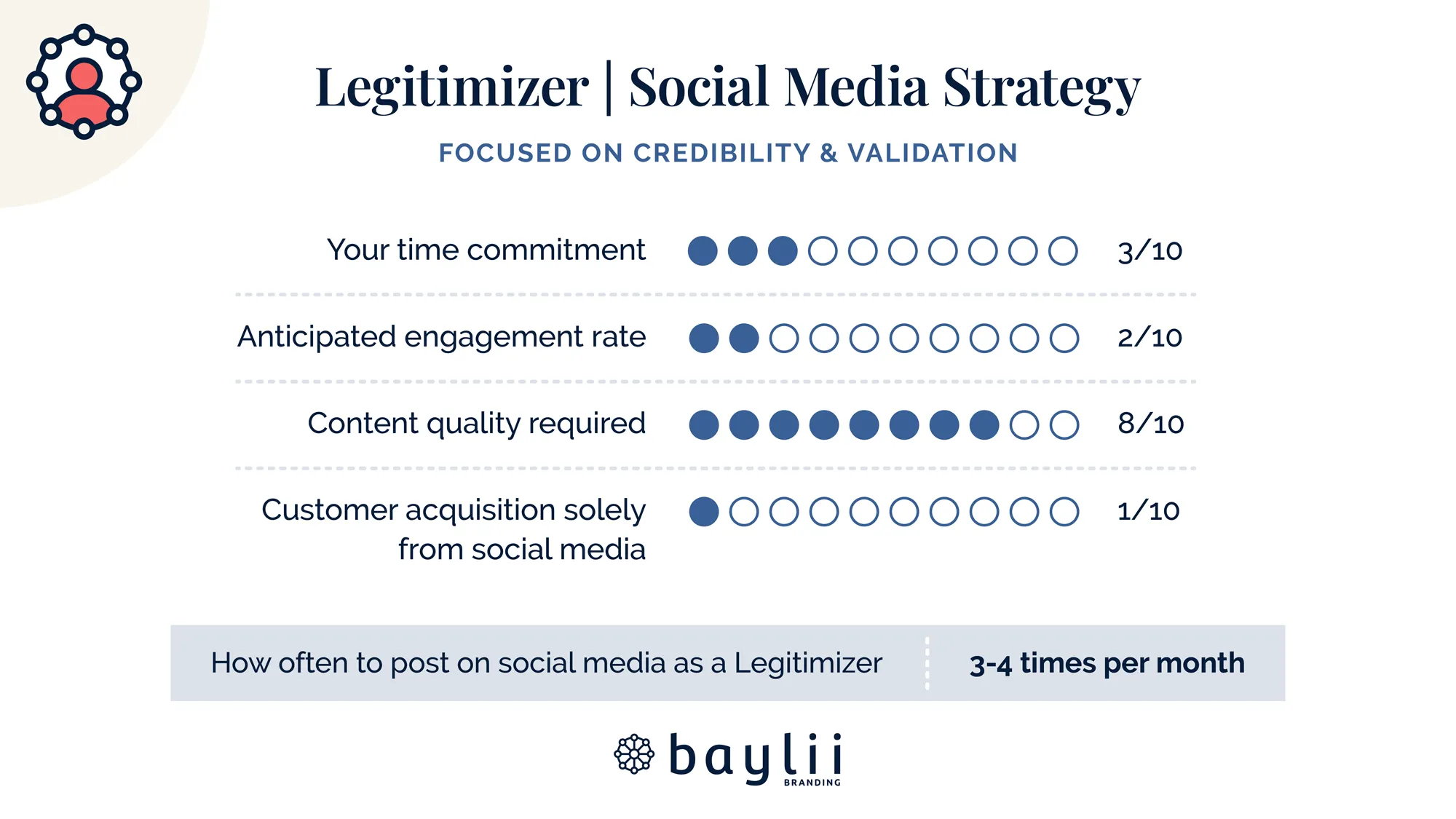
The Legitimizer's numbers tell a clear story: low time investment, low engagement, and social media as a last-mile credibility check rather than a lead source. Your time commitment is light because you're not trying to feed an algorithm. You're maintaining a presence that holds up under scrutiny. Engagement from your followers will be minimal, and that's fine. Most profile visitors aren't there to interact; they're there to decide. New customers sourced directly from social will be low because social isn't where they found you, it's where they confirmed you.
The one metric you can't let slide is content quality. The quality bar here is high — not because you need polished, production-level content for every post, but because every post you do share carries more weight. Quality means the content serves your purpose: it looks like your brand, it shows what you do, and it makes someone feel confident about choosing you.
How often to post on social media as a Legitimizer: 3-4 times per month.
This might be you if: You have a strong marketing ecosystem, social media has never been your primary lead source, and your bandwidth for content creation is limited. You want your profiles to work for you — not demand everything from you.
The Storyteller
What it is: You have a natural reservoir of content to draw from, and sharing it consistently keeps your audience connected and engaged. Social media marketing for nonprofits often fits squarely here — the work you do, the people you serve, the milestones you hit, the behind-the-scenes moments — it all translates to content that people genuinely want to see. Research from Georgetown University's Center for Social Impact Communication found that 55% of people who engage with a cause on social media are inspired to take further action. But this category also fits service-based businesses, community-rooted brands, and anyone whose work tells a story worth following.
The Storyteller’s social presence cultivates retention and relationship, and acquisition is achieved by compelling people to be part of your work. You're keeping existing supporters, customers, and advocates warm, and giving them something worth sharing with their own networks. New followers do find you this way, but the engine runs on connection more than conversion.
What this looks like in practice: A steady flow of content (a few times a week) that mixes real moments with polished pieces. You engage with your community when they interact with your posts, and you occasionally tag or interact with partner brands and organizations. Knowing what to post on social media for your business in this category is rarely the hard part. The challenge is maintaining a consistent rhythm. You're not trying to hack the algorithm or build a viral moment; you're building trust over time through consistent, authentic presence.
What to expect from organic social media marketing as a Storyteller:
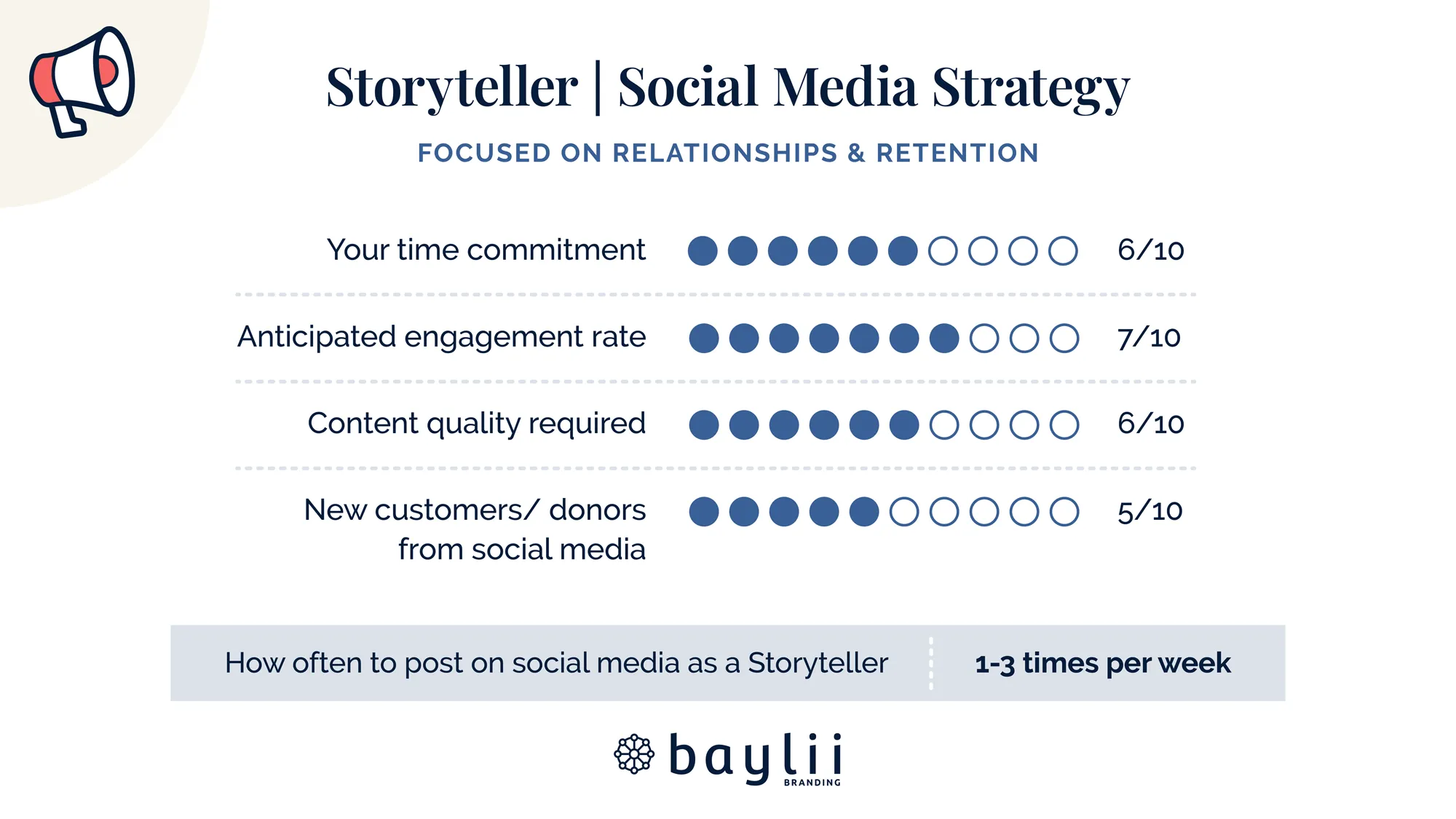
The Storyteller's metrics reflect a strategy doing real, sustained work. Time commitment climbs to a solid mid-range, requiring a few dedicated hours each week, not stolen minutes. In return, engagement is genuinely strong. Mission-driven, people-focused content tends to resonate in ways more transactional content doesn't. New customers will find you organically as your content does its work but this is only a piece of your marketing strategy—not the entirety. Quality and quantity live in equal balance here: not every post needs to be a showstopper, but the overall feed should feel intentional. Raw, real content often out-performs anything highly produced — as long as it's genuine.
How often to post on social media as a Storyteller: 1–3 times per week.
This might be you if: Your work is inherently visual or emotionally resonant, your audience has a strong affinity for what you stand for, and you have regular access to content opportunities (events, client stories, behind-the-scenes moments). You're willing to commit a few hours a week to social media and understand that the payoff is relationship-building more than a direct sales pipeline.
The Community Builder
What it is: Social media is a genuine revenue and lead channel for your business — not a supporting actor. You're not just showing up; you're working the platforms. That means going live consistently, nurturing Facebook Groups, actively engaging with other brands and creators, responding to comments religiously, and pulling every lever Meta, TikTok, Youtube, and/or LinkedIn have to offer. This is a serious, sustained investment of time and strategic energy.
Community Builders treat social media the way other businesses treat sales — it's a primary function, not a side task. The brands who do this well understand that the algorithm rewards activity, and that the real competitive advantage isn't just great content — it's showing up more consistently and more authentically than everyone else in their space.
What this looks like in practice: Daily posting across platforms, a mix of high-quality cornerstone content and faster-produced everyday content, regular live sessions, community management across comments and DMs, and an ongoing strategy for collaboration and brand interaction. When people ask how often to post on social media for this kind of strategy, the honest answer is: every day, and sometimes more. This is a role, not a to-do list item.
What to expect from organic social media marketing as a Community Builder:
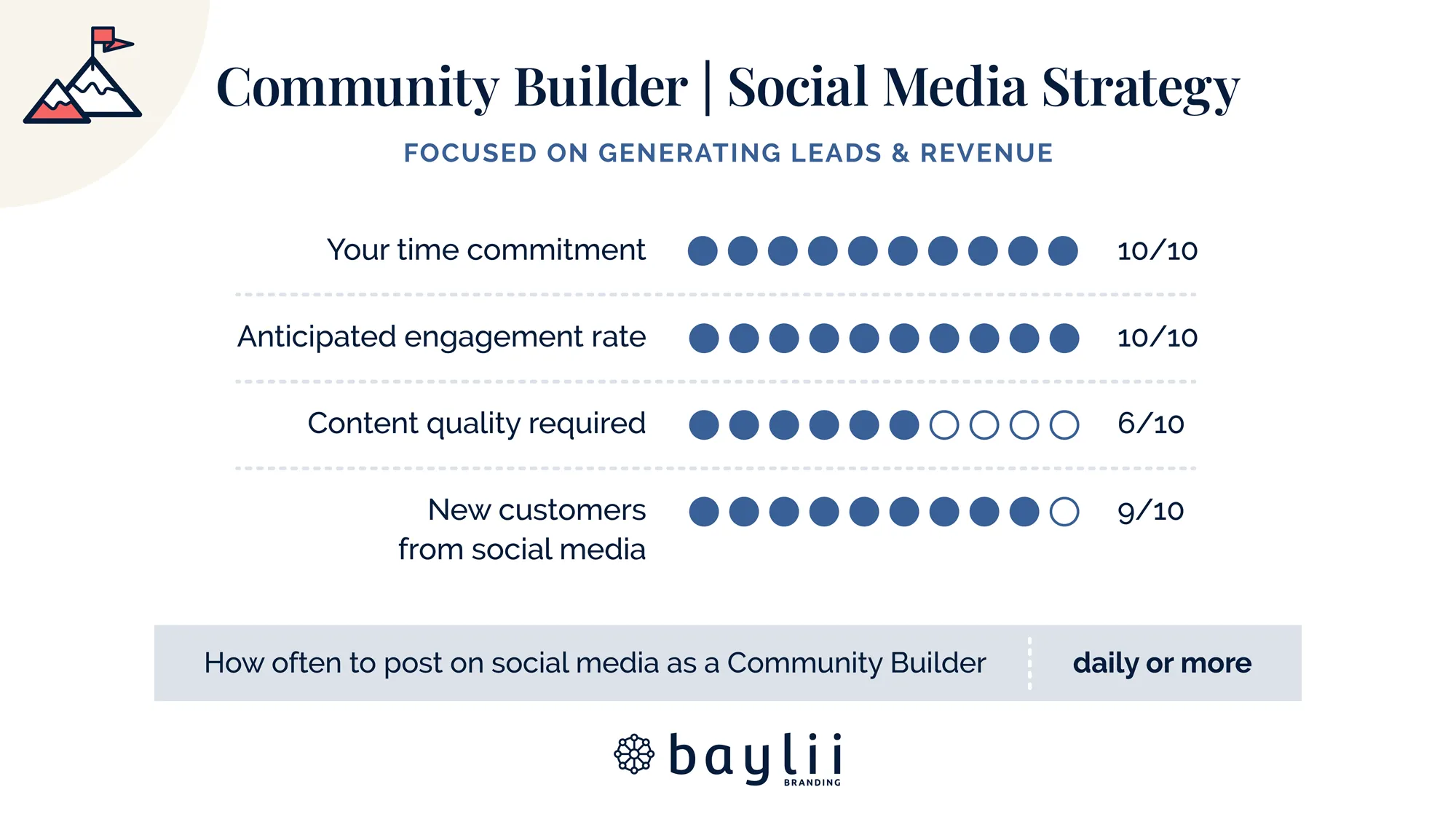
The Community Builder's metrics are the most demanding of the three — and the most rewarding in terms of revenue. Time commitment is at maximum, and that number deserves real respect before you commit. Managing groups, going live, engaging with other brands — this is closer to a part-time (or full-time!) job than a marketing task, and brands that treat it as anything less tend to fall short on their goals. Engagement and new customer acquisition are both at their ceiling because you've earned them. The one number that might surprise you is content quality at 6 out of 10. At this volume, chasing perfection is a trap. The strategy calls for a mix of high-production cornerstone content and a larger stream of faster, more spontaneous posts. Speed and consistency beat perfection here every time — and if you’re paying attention, your community of followers will tell you what they want, what moves them, and what drives leads.
How often to post on social media as a Community Builder: Daily or more.
This might be you if: You have the time, team, or budget to treat social media as a primary marketing channel, your product or service has broad consumer appeal (or you come up with an angle to make it appealing!) and is naturally shareable. You also have to be genuinely willing to show up — live, in comments, in communities — day after day. This category delivers the highest return, but it only works if you go all in.
Which Social Media Strategy Is Right for Your Business?
Here's what we've learned from working with dozens of small businesses and nonprofits: many businesses try to be a Community Builder on a Legitimizer's schedule, and then wonder why they're not getting Community Builder results. Misaligned expectations create frustration, wasted effort, and a feed full of half-hearted content that doesn't serve anyone.
The most strategic thing you can do isn't to figure out what to post on social media for your business today — it's to get honest about what category fits your capacity and your goals, and then develop a strategy to execute that category really well.
None of these categories exists in a vacuum, either. Any of them can be amplified significantly by layering in boosted posts and paid advertising when the time is right.
Not sure which category you're in — or which one you should be in? That's exactly the kind of conversation we help clients sort through. Let's talk.